Understanding 3 Types of Attachments on Komatsu Excavators
In various construction, mining, and forestry projects, the excavator is one of the most frequently used pieces of heavy equipment. This machine is known for its strong digging capability, high mobility, and flexibility for working on various types of terrain.
The role of an excavator is not limited to digging soil. With a powerful hydraulic system and a precise arm and boom design, this equipment can support a range of activities, including material handling, structural demolition, and loading.
However, an excavator’s capability is not determined solely by the main machine. One of the most important factors that determines productivity is the attachment being used.
An attachment functions as an additional working tool installed at the end of the excavator arm. With the right attachment, one excavator unit can perform many different types of jobs.
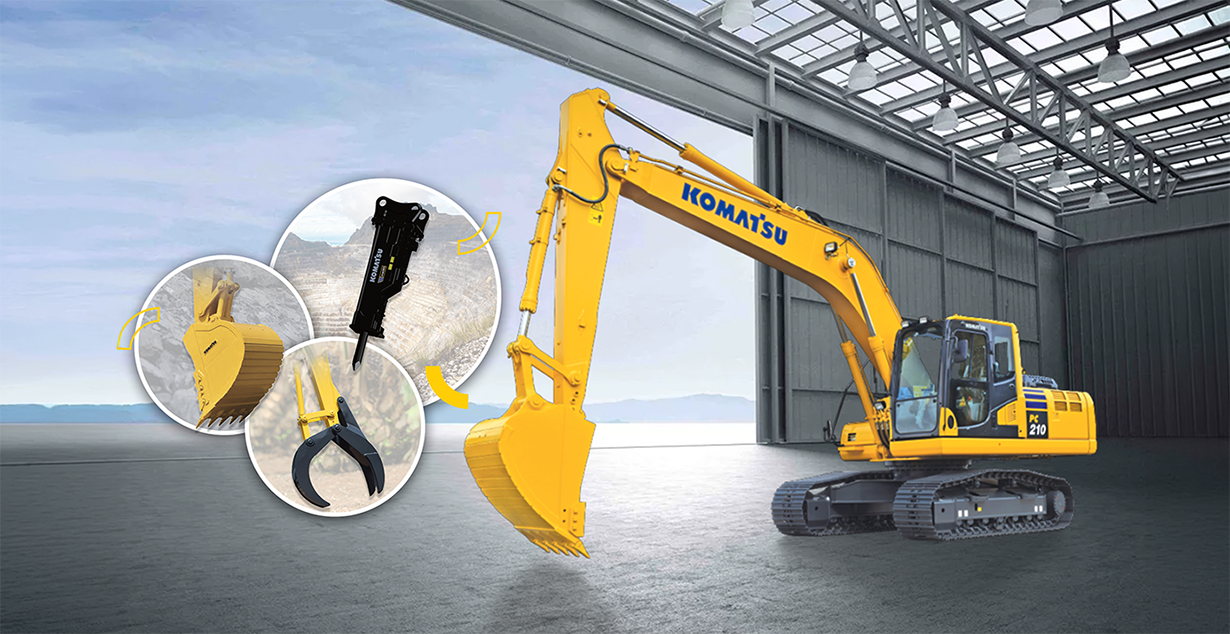
Therefore, selecting the right attachment becomes essential in excavator operations. This article discusses three popular attachment types commonly used on Komatsu excavators, namely bucket, grapple, and breaker, and how each attachment supports different field work requirements.
What Is an Attachment on an Excavator and Why Is It Important?
An attachment on an excavator is an additional device installed at the end of the arm to perform specific work. This component enables an excavator to perform multiple tasks without replacing the main machine.
In practice, attachments play an important role in improving the flexibility and efficiency of heavy equipment. By changing the attachment, operators can adjust the excavator function according to the job being performed.
For example, soil excavation projects typically use a bucket, while jobs involving moving logs or large materials are more effective with a grapple. For demolition tasks involving concrete or hard rock, a breaker attachment is the most suitable option.
Attachment systems also distinguish excavators from other heavy equipment, such as loaders. Loaders usually use a bucket as a permanent implement, while excavators are designed to work with multiple interchangeable attachments depending on job requirements.
In other words, attachments are one of the reasons why excavators are known as highly versatile heavy equipment across many industries.
3 Types of Attachments on Komatsu Excavators and Their Functions
1. Bucket, The Primary Tool for Excavation Work
The bucket is the most common attachment used on excavators. Almost all basic excavator operations use this attachment because of its essential role in digging activities.
- Main Function
The bucket is used for digging, loading, and moving materials such as soil, sand, and gravel. Its curved design, combined with sharp teeth at the front, helps it penetrate the ground more easily and efficiently.
● Advantages of This Attachment
One of the main advantages of a bucket is its ability to perform precise excavation. Operators can control digging depth and volume more accurately, making tasks such as foundation digging or drainage work more organized and efficient.
Buckets are also available in different sizes and types depending on the excavator capacity. This allows better adjustment to specific job requirements and material conditions.
As a product reference, Komatsu excavators, such as the Komatsu HB365-1, are designed to work efficiently with various bucket types to enhance excavation productivity on construction and mining projects.
2. Grapple, An Effective Solution for Large and Irregular Materials
Another important excavator attachment is the grapple. This tool is designed to handle materials that are difficult to move using a standard bucket.
● Main Function
The grapple is used to grip, lift, and move large or irregular materials, such as logs and tree trunks.
● Advantages of This Attachment
The main advantage of a grapple is its powerful hydraulic gripping system. This mechanism allows operators to securely hold materials, making transportation safer and more efficient.
Additionally, its flexible design makes the grapple ideal for forestry, waste processing, and demolition work.
For example, excavators such as Komatsu PC135F-10M0 are commonly used in forestry operations because they are compatible with grapple attachments designed specifically for efficient log handling.
3. Breaker, A Reliable Attachment for Breaking Hard Materials
A breaker is an attachment used for demolishing or destroying hard materials.
● Main Function
This attachment works by producing high-pressure hydraulic impacts capable of breaking hard materials such as concrete, large rocks, or structural components.
● Advantages of This Attachment
Breakers have an extremely powerful impact force, allowing demolition work to be completed much faster compared to manual methods. In addition, using a breaker on an excavator improves operational efficiency because operators can break materials and move debris with the same heavy equipment.
In addition, using a breaker on an excavator improves operational efficiency because operators can break materials and move debris using the same heavy equipment unit.
As a reference, excavators such as the Komatsu PC210-10M0 can be equipped with breaker attachments to support concrete demolition and rock-breaking tasks in construction projects.
Comparison of Excavator Attachment Advantages
To make it easier to understand, the following table summarizes the three most common excavator attachments.
| Attachment Type | Main Function | Target Material | Key Advantage |
| Bucket | Digging and loading material | Soil, sand, gravel | High excavation force & precision |
| Grapple | Gripping and moving materials | Logs | Strong and flexible grip |
| Breaker | Breaking hard materials | Concrete, large rocks | Powerful and fast hydraulic impact |
When Should You Use the Right Attachment?
Using the right excavator attachment should always match the job requirements in the field.
- Determine the main objective of the task. If the project involves soil excavation or material loading, a bucket is the most appropriate choice. However, if the work requires moving large materials, such as logs or metal waste, a grapple will be more efficient.
- Consider the terrain condition and the material being handled. Hard materials such as concrete or rock require a breaker attachment to achieve faster, more effective demolition.
- Ensure the attachment is compatible with the excavator capacity. The attachment’s size and weight must match the boom’s capability and the hydraulic system so the equipment’s performance remains optimal.
Tips for Choosing the Right Excavator Attachment
Choosing the right attachment can improve productivity while extending the lifespan of heavy equipment. The following tips can help guide the selection process.
- Ensure the attachment is compatible with the excavator model being used. Compatibility includes the boom size, arm structure, and mounting system.
- Consider the hydraulic flow and hydraulic pressure capacity. The hydraulic system must support the attachment operation to achieve optimal performance.
- Select attachments with OEM quality standards to ensure safety and reliability. Original manufacturer attachments are generally designed specifically to match the machine specifications.
- Conduct regular inspections and maintenance. Proper maintenance helps maintain attachment performance while extending its service life.
FAQ About Excavator Attachments
1. What is the difference between a grapple and a bucket clamp?
A grapple features a dedicated hydraulic gripping system to hold large materials, such as logs or scrap metal. Meanwhile, a bucket clamp is typically an additional feature attached to a bucket to help grip materials, but it does not provide the same flexibility as a grapple.
2. Can a breaker be used on hard soil besides rocks?
Yes. A breaker can be used to break various hard materials such as concrete, rock formations, or extremely compacted soil. However, its use must still comply with the excavator’s specifications.
3. How do you choose the right bucket size?
Bucket size should match the excavator capacity, the type of material being excavated, and the required work volume. Choosing the correct size helps improve efficiency while reducing machine workload.
The Right Attachment Makes Excavators More Versatile
Attachments play an important role in expanding an excavator’s capabilities across various types of work. By choosing the right attachment,, such as a bucket, grapple, or breaker, a single excavator unit can be used for a range of project needs, from excavation to breaking hard materials
Selecting the appropriate attachment also helps improve work efficiency, maintain heavy equipment performance, and optimize productivity in the field.
Choosing attachments through United Tractors means you not only get world-class products, but also support from a partner committed to your success, in line with the spirit of Moving as One: One Commitment, One Spirit, One Synergy.
If you want to find the most suitable attachment for your project needs, contact UT Call at 1500 072 (24/7) to get product information and consultation from United Tractors.